
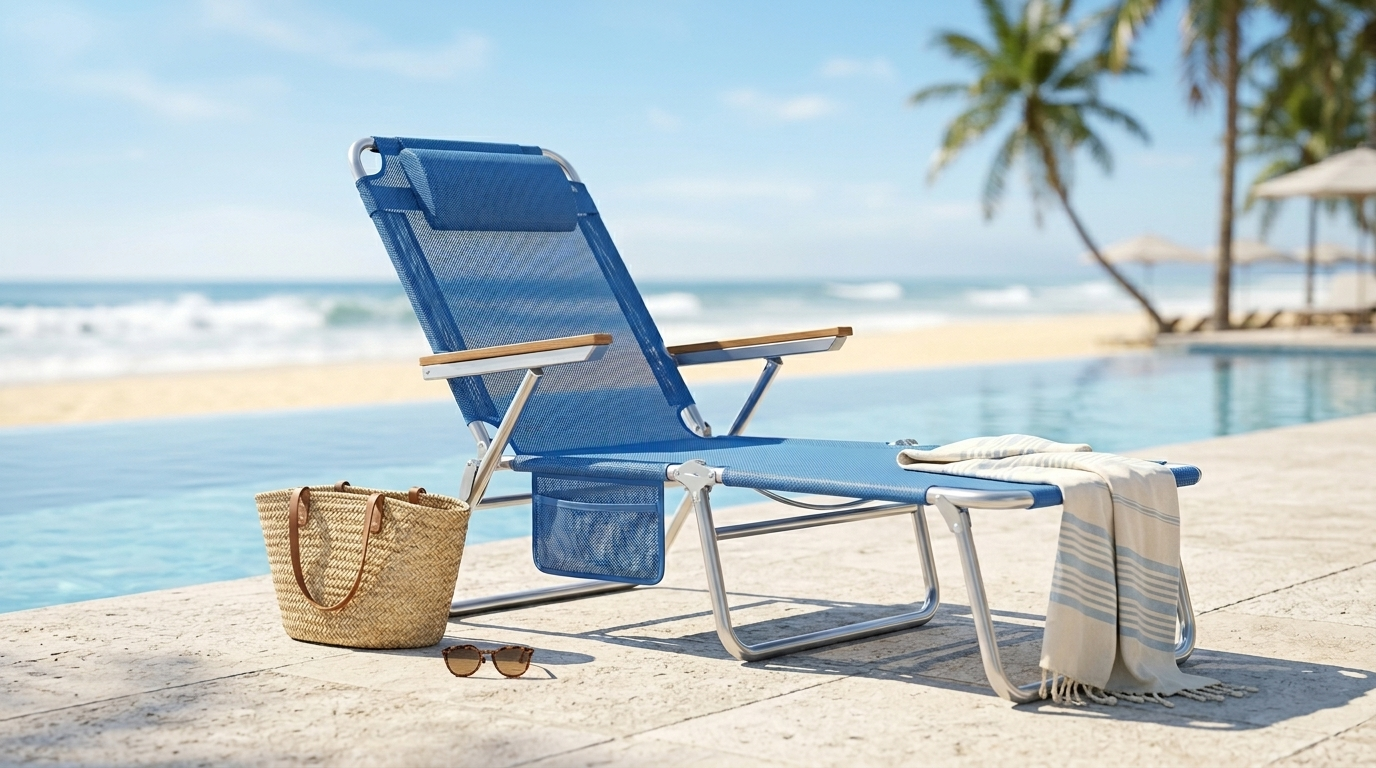
A good tanning chair gives you steady support and easy ways to adjust your position so you stay comfortable for hours in the sun. The best choice depends on where you use it most, how much you weigh, and whether you need to carry it far.
Focus first on weight capacity, frame material, and recline options that match your tanning style. Many buyers regret picking a chair that feels flimsy or sinks in sand.

Quick Selection Checklist: 6 Essentials for Sun Lovers
Before you get into the specifics, use these standards to narrow down your choices. A high-quality tanning chair should meet most, if not all, of these criteria:
- Weight Capacity: Look for a rating at least 20% higher than your body weight to account for "dynamic loading" (the force of sitting down).
- Stability Base: Choose U-shaped frames or "s and feet" for soft beaches; four-legged chairs are better for flat pool decks.
- Recline Range: Ensure at least 4 positions, including a "lay-flat" or "near-flat" option for even back tanning.
- Fabric Breathability: Prioritize PVC-coated polyester mesh (like Textilene) to prevent heat trapping and "sticky" skin.
- Portability: If walking more than 50 yards, look for backpack straps and a total weight under 12 lbs.
- Seat Height: Low-profile (6-8") for sand stability; high-profile (12-17") for easier entry/exit if you have knee or back concerns.
What Makes a Good Tanning Chair in the First Place?
A tanning chair works as a reclining outdoor lounger built for lying back and getting even sun exposure. Sun lovers need more than a basic seat. They look for good back support, breathable fabric, and a design that holds steady on different surfaces.
Most chairs in this category fold for storage and include simple adjustments. The frame and seat material decide how long the chair lasts in salt air, sand, and direct sun. Buyers often check for wide seats and armrests that feel natural when relaxing for long periods.
Adjustability: How Many Recline Positions Do You Really Need?
Recline positions make a big difference in how well a chair works for tanning. Four positions usually give enough flexibility to move from sitting up to reading and then to a nearly flat spot for even sun on your back or stomach.
Three positions cover basic sitting and lounging but often leave you short for stomach tanning. Five positions add small tweaks that help some people nap or fine-tune their angle. The key is having at least one near-flat setting so you avoid neck strain while you tan.
This chart helps show how recline level pairs with different surfaces.

|
Category |
Concrete or deck |
Packed sand |
Loose sand |
|
Flat recline / lay-flat |
3.0 |
2.0 |
1.0 |
|
Moderate recline |
3.0 |
2.0 |
1.0 |
|
Upright lounge |
2.0 |
1.0 |
1.0 |
Material and Durability: Decoding Weight and Weather Resistance
Frame material affects how well your chair holds up near the ocean. Aluminum stands out for coastal environments because it resists rust from salt air and moisture better than standard steel. Steel can work for backyard use if it has a strong powder coating, but aluminum usually stays lighter and lasts longer at the beach.
Understanding Weight Ratings
When checking product specifications, you may see references to ASTM F1561-13 standards, which test for static loads up to 400 pounds. While this is a great benchmark for commercial-grade durability, most consumer chairs are rated between 225 and 300 lbs.
Expert Tip: If a product page doesn't list a weight rating, look for "thick-walled tubing" or "reinforced joints" in the description. A reliable rule of thumb is to choose a chair with a 50-lb "safety buffer" above your actual weight to ensure the frame doesn't flex or fatigue over time.
Seat Fabric
Mesh styles let air flow through so your back stays cooler and drier. These fabrics also dry fast after a swim or rain. Solid fabrics can trap heat and feel sticky during long tanning sessions.
Stability Mechanics: Preventing the "Sand Sink"
Soft sand creates a common problem for tanning chairs. To stay steady, a chair needs to spread weight across a larger surface area. While engineering tests often aim for low pressure (under 10 PSI) to prevent sinking, you can verify this visually when shopping:
U-Shaped Bases: These are the gold standard for sand. By connecting the legs into a continuous bar, the weight is distributed across the entire length of the bar rather than four small points.
Sand Feet: If the chair has four legs, look for "oversized" or "pivoting" feet. These act like snowshoes for your chair.
On concrete or packed surfaces, higher seats make it easier to stand up, but they can feel less stable on uneven ground. Anti-slip rubber feet are essential for wet pool decks to prevent sliding.
Specialized Types: High-Back, Extra-Wide, and Face-Down
Not all tanning chairs are built for the same body type or preference. Look for these specific "long-tail" features if you have unique needs:
- High-Back Loungers: Best for taller users (over 6'0"). Look for a backrest height of 30 inches or more to ensure your head is supported when reclining.
- Extra-Wide Seats: Standard chairs are roughly 19-21 inches wide. "XL" or "Wide" models offer 24-26 inches of space, which provides better stability and comfort for broader frames.
- Face-Down Styles: These include a padded hole for your face and arm slots. This is the best choice if you spend 50% or more of your time tanning your back, as it prevents neck torque.
- Integrated Accessories: Look for "swing-out" cup holders or side pockets. Ensure the cup holder is positioned low on the frame so it doesn't shift the chair's center of gravity when holding a heavy drink.

Common Tanning Chair Mistakes to Avoid
Many buyers focus only on the lowest price and end up with a chair that breaks or feels uncomfortable after a few uses. A disposable chair often ends up in the trash after one season. Checking weight rating and frame strength first saves money in the long run.
Another mistake is ignoring the "carry weight vs. folded size" ratio. A heavy model without good straps turns a short walk into a tiring chore.
- Verification Tip: Check the "folded dimensions" in the product specs. If it's longer than 30 inches, it may not fit easily in a standard car trunk.
Some people skip checking fabric breathability. A chair that holds heat makes you sweaty and uncomfortable in direct sun. Always look for mesh or quick-dry materials when you tan for hours at a time.
Selecting Your Perfect Lounger: The Final Checklist
- Match the Surface: U-frame for sand; 4-leg for patio.
- Verify the Load: Body weight + 20% safety margin.
- Check the "Flatness": Does it recline to at least 170 degrees for stomach tanning?
- Confirm Portability: Does it have backpack straps or a carry handle?
- Inspect the Hardware: Look for stainless steel or plastic-coated bolts to prevent "rust streaks" on the fabric.
Frequently Asked Questions
Q1: What is the best material for a tanning chair?
Aluminum frames paired with breathable mesh fabric usually last longest near the beach. Aluminum resists rust from salt air, and mesh stays cooler and dries faster than solid cloth.
Q2: How many reclining positions should a good lounger have?
Four or five positions give the most flexibility for tanning. This range lets you sit upright, read, lounge, and reach a nearly flat spot for stomach tanning.
Q3: Are tanning chairs easy to carry?
Many fold compactly and include shoulder straps. Look for models under 12 pounds if you walk long distances on sand or travel often.
Q4: Can I use a tanning chair at home?
Yes. These chairs work well on patios, in backyards, or beside a pool. Pick a higher seat for easy entry and exit on hard surfaces.
Q5: What should I do if my chair sinks in sand?
Choose a low lounger with wide feet or a U-shaped base. These designs spread weight better and reduce sinking on soft surfaces.
Q6: How do I clean a tanning chair after beach use?
Shake off sand, rinse with fresh water, and wipe with mild soap. Let the chair dry completely before folding to prevent mold or corrosion.


Leave a comment
This site is protected by hCaptcha and the hCaptcha Privacy Policy and Terms of Service apply.