
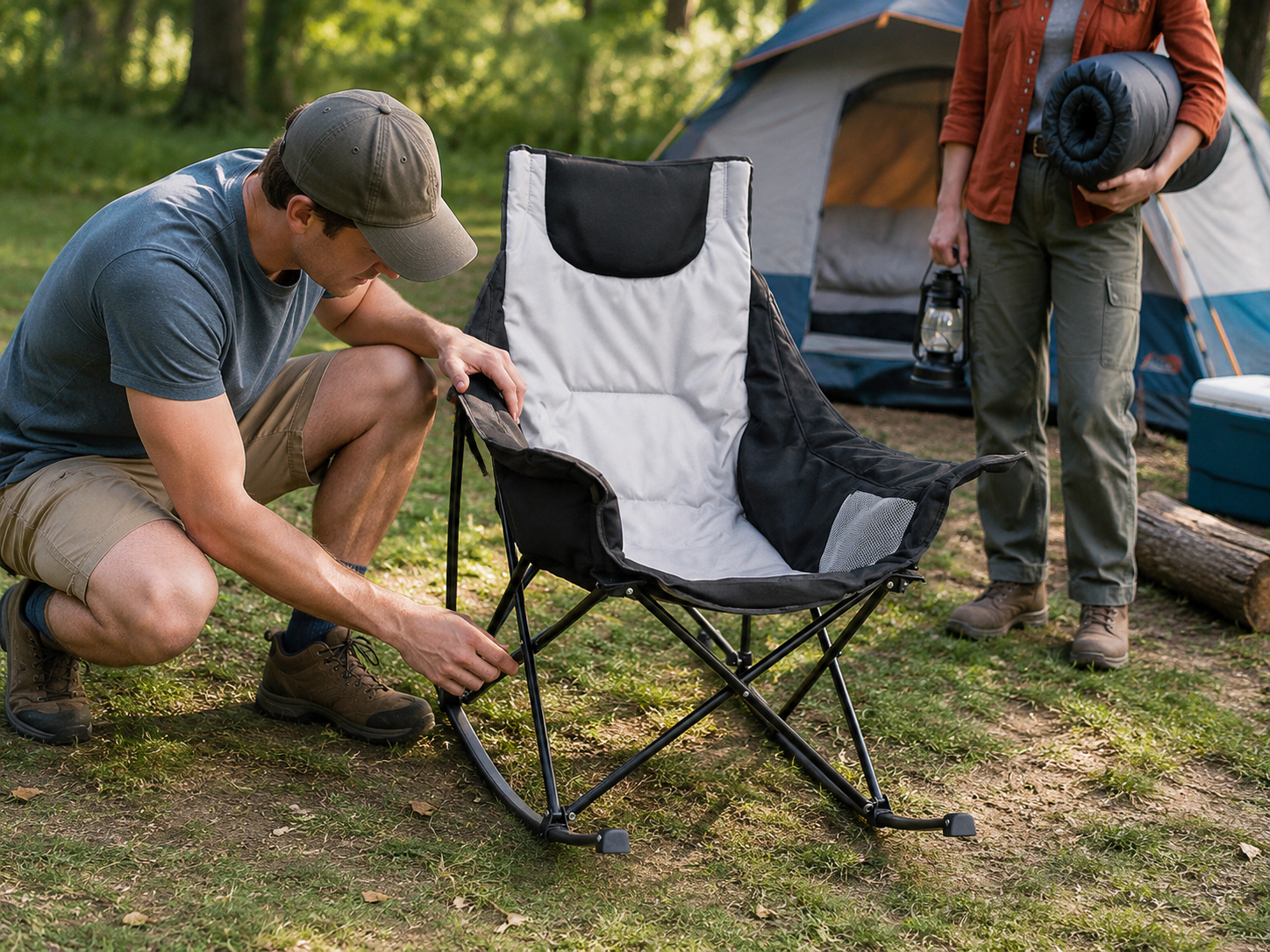
Camping chairs usually fail in the same few ways, and most of them are catchable early. The big things to watch are overload, worn joints, fabric stress, and moisture damage. Treat the weight limit as a limit, not a comfort target, and you will avoid a lot of preventable problems.

Why Camping Chairs Usually Fail
In real use, camping chairs take more abuse than they look like they should. Folding-chair performance standards, such as ASTM F1561 testing, focus on load, impact, and fatigue because repeated use matters as much as the first sit.
Overweight Loads and Dynamic Stress
A chair can be stressed by your body weight and by how you sit down. Dropping into it, rocking, or leaning hard can create dynamic stress that is harsher than the number on the tag suggests.
The practical rule is simple: if a chair is already near its listed limit, treat it as a poor fit for rough use. If you want more margin for tailgates, family events, or heavier use, look for sturdier construction rather than assuming all camping chairs behave the same.
Joint Wear, Rivets, and Frame Fatigue
Folding joints and rivets take the repeated hit of setup, folding, and shifting weight. Over time, those points can loosen even when the rest of the chair looks normal. Wobble, clicking, and side-to-side play are often the first clues that the frame is starting to fatigue. Understanding common joint wear patterns before you buy can help you avoid chairs that are prone to early fatigue.
Thin tubing can also flex more under regular use, which may speed up wear. If the chair feels loose when you sit down, do not write it off as "just age." That movement is often a sign that the load path is changing.
Fabric Stretch, Tear Points, and Stitch Failure
Fabric usually fails where stress concentrates, not in the middle of a smooth, evenly loaded panel. Look closely at seams, corners, armrest attachments, and the seat edges that carry the most pull. Fraying or sagging in those areas usually matters more than a small scuff on the surface. Knowing how different fabric materials handle stress helps you pick a seat that holds up at the points that matter most.
When fabric no longer matches the frame well, the chair can start to feel baggy or uneven. That extra movement shifts more work onto the stitching and corners, which is how a comfortable-looking seat becomes a weak one.

Rust, Moisture, and Storage Damage
Rain, humidity, wet grass, and salt air can all shorten chair life. If moisture stays trapped in a folded chair, corrosion can start on hardware and joints while the fabric holds dampness against the frame. Even if the damage begins on the surface, it can eventually affect the parts that matter most.
Drying the chair and storing it in a sheltered place is a basic way to slow that process. It is not a guarantee, but it is one of the easiest habits to build if you use collapsible camping chairs often.
Warning Signs to Check Before a Collapse
The fastest checks are the ones you can do in seconds before a trip or after the season ends. Early warning signs do not prove the chair is about to fail, but they do tell you to inspect more closely. If you notice more than one of these, treat the chair as a candidate for repair or retirement.
- Wobble when you sit down: A chair that shifts side to side can be losing stiffness in the frame or joints.
- Clicking or popping sounds: Noise during movement often points to play in the rivets or folding points.
- Loose hardware or visible slack: Any extra movement at a pivot is worth checking before the next outing.
- Fraying at seams or corners: Wear near stress points usually matters more than cosmetic wear on flat fabric.
- Bent tubing or uneven legs: Distortion in the frame is a stronger concern than scratches or paint loss.
- Rust around hinges or load-bearing parts: Surface rust is one thing, but corrosion where parts carry weight deserves closer attention.
Read chair specifications before you buy or keep using a chair if you are unsure whether the size, weight capacity, or materials match your setup.
How to Prevent Premature Failure
- Check the chair before every trip. Open it fully, sit down slowly, and make sure the frame feels level. If it rocks or clicks, inspect the joints before you trust it for a long day.
- Use it within its intended range. Staying inside the listed limit can reduce stress, but the chair still needs reasonable use. Sudden drops, aggressive rocking, and uneven loading all shorten life.
- Keep fabric and hardware clean. Dirt, sand, and grit can work into the joints and seams. A light cleaning routine helps the chair move smoothly and makes wear easier to spot.
- Dry it fully after wet use. If the chair got damp, let it dry before folding and storing. That simple step can slow rust and help protect the fabric.
- Store it off wet ground. A dry, sheltered spot is better than leaving it in a garage corner or truck bed where moisture lingers.
If you want a simple care routine, clean and care for outdoor chairs the same way you would other outdoor gear: remove dirt, wash gently, and dry fully before storage.
Which Chair Features Reduce Failure Risk
The best chair for failure resistance depends on how you use it. A weekend camper, a tailgater, and a larger user do not need the same balance of size, padding, and packability. The table below helps you judge features by what they change in real use, not by sticker price alone.
|
Feature |
Why It Matters |
What To Look For |
Common Trade-Off |
|
Frame style |
A stronger frame usually handles repeated sitting and folding better |
Stiff, stable construction that does not flex wildly |
Often weighs more or packs larger |
|
Fabric robustness |
Heavier-duty fabric can better resist stretching at stress points |
Material that looks dense and well-stitched |
May add bulk or reduce breathability |
|
Seat width |
More room can improve fit and reduce side stress |
A seat that matches your body size and sitting style |
Wider seats usually take up more space |
|
Support style |
Better support can reduce wobble and sag |
Secure armrests, solid joints, and balanced geometry |
Extra support can mean less compact storage |
|
Packed size |
Smaller chairs are easier to carry, but sometimes less stable |
A carry size you will actually bring and use |
Ultralight designs may sacrifice stiffness |
|
Body-size fit |
A chair that fits you well is less likely to feel strained in use |
Enough room to sit naturally without forcing the frame |
Oversized options are less compact |
For buyers who want a sturdier starting point, a heavy duty camping chair is worth checking only if the size, fabric, and storage trade-offs fit your use. For broader browsing, the camping chair selection makes sense when you are comparing different builds side by side.

Repair, Replace, or Upgrade
Use repair for local, cosmetic, or isolated problems that do not affect how the chair carries weight. If the issue is limited to a small fabric patch, a loose accessory, or another non-structural part, a repair may be enough. But persistent wobble, bent tubing, repeated seam failure, or rust on load-bearing parts usually mean it is time to replace or upgrade.
A good decision test is simple: if the chair still sits level and the damage is local, fix it. If the frame feels compromised, retire it. If you use camping chairs often, or if cost-per-use matters more than the lowest sticker price, an ergonomic heavy-duty chair can make more sense than another short-term patch.
Check Your Camping Chair and Stay Safe
Camping chairs fail for predictable reasons, so you do not have to treat every wobble as a mystery. Check the frame, joints, fabric, and storage habits first. If the damage is cosmetic, repair may be enough. If the chair wobbles, bends, or keeps wearing at stress points, replacement is usually the better call.
FAQs
Q1: Why Do Camping Chairs Usually Collapse?
Most collapses come from a mix of overload, joint wear, fabric stress, and corrosion. A chair can look fine and still be weakening at the rivets or folding points. The real risk grows when the frame, fabric, and hardware all start aging at the same time.
Q2: What Are the First Signs a Camping Chair Is Wearing Out?
Watch for wobble, clicking, loose play in the joints, fraying near seams, and bent tubing. None of those means instant failure on its own, but they do mean the chair deserves a closer look before the next trip.
Q3: Can a Camping Chair Last Longer If You Use It Within the Weight Limit?
Usually, yes, staying within the listed limit helps reduce stress. But lifespan still depends on how often you use the chair, how you sit in it, and whether you dry and store it properly after trips.
Q4: How Should You Store Camping Chairs to Prevent Rust and Wear?
Dry them fully before folding, keep them off wet ground, and store them in a clean, sheltered place when possible. That routine helps reduce trapped moisture, which is one of the easiest ways for rust and fabric breakdown to start.
Q5: What Should You Look for in a More Durable Camping Chair?
Focus on a stable frame, sturdy fabric, secure joints, and a seat size that fits your body without forcing the chair to work harder than it should. If you use it often or carry more weight, a heavier-duty build may be a better value over time.




Leave a comment
This site is protected by hCaptcha and the hCaptcha Privacy Policy and Terms of Service apply.