
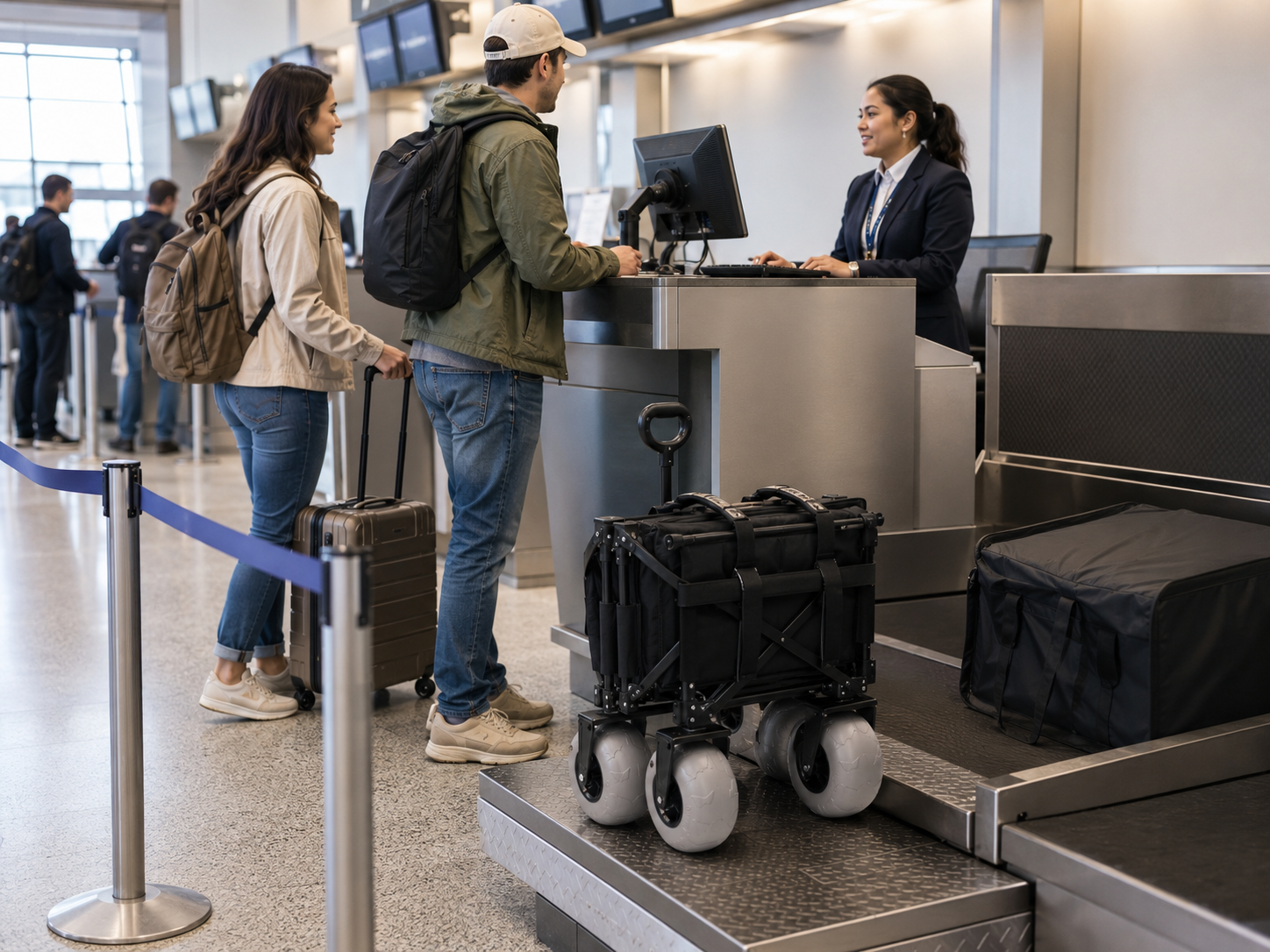
Hauling tents, coolers, and gear through a busy airport is exhausting. A folding wagon makes it easy to roll your bags right to the terminal. But flying with these carts can get complicated. Airlines and security teams have strict, confusing rules for utility wagons. Here is what you need to know to fly with your cart, pack it safely, and avoid unexpected fees.

First Things First: What Counts as a "Folding Camping Wagon"?
Clear definitions help prevent check-in issues because airline agents classify wheeled devices based on their structure, size, and safety features.
Defining a folding camping wagon, foldable wagon cart, or utility cart requires looking at its structural elements. These units are typically constructed from robust canvas fabrics, such as double-layer polyester, stretched over an accordion-style metal frame that collapses down into a compact footprint. An off-road portable folding wagon typically features thick plastic or rubber wheels designed for sand, gravel, and dirt paths. Average collapsed dimensions of a travel folding cart hover around 30 by 20 by 9 inches, with a total empty weight ranging between 15 and 30 pounds.
This utility gear must be clearly distinguished from dedicated stroller wagons designed for children. Stroller wagons are equipped with integrated safety harnesses, footwells, and specialized push-pull handles specifically to transport young passengers safely. Furthermore, standard utility folding wagons lack these safety straps and are designed purely for bulk cargo. Additionally, these items differ from rigid airport baggage trolleys or heavy commercial shopping carts, which do not collapse and are restricted to terminal buildings.
This distinction is a key factor in how airlines and airports apply their rules. Major carriers often allow stroller wagons to be checked free of charge as baby equipment. On the other hand, standard utility folding wagons used purely for cargo do not qualify for this waiver and are processed as standard checked bags, subject to regular luggage fees. Thus, using a personal folding luggage cart instead of paid terminal carts can save money, but it requires careful navigation of these rules.
|
Feature Category |
Utility Camping Wagon |
Dedicated Stroller Wagon |
Standard Airport Trolley |
|
Typical Folded Dimensions |
30 x 20 x 9 inches |
32 x 22 x 11 inches |
Rigid, non-collapsible frame |
|
Average Empty Weight |
15 to 30 pounds |
25 to 45 pounds |
35 to 50 pounds |
|
Safety Equipment |
None (missing passenger harnesses) |
Integrated 3-point or 5-point harnesses |
No safety equipment provided |
|
Primary Structural Frame |
Steel or aluminum accordion style |
Heavy-duty alloy frame with suspension |
Rigid steel tubing and heavy basket |
|
Airline Fee Treatment |
Standard checked bag fees apply |
Often checked free of charge |
Subject to local terminal rentals |
Can You Take a Folding Camping Wagon on a Plane?
Transporting a collapsible wagon on commercial flights is possible, but success relies on selecting the correct baggage method and adhering to airline-specific size restrictions.
Carry‑On vs Checked Baggage vs Gate‑Checked
Baggage policies vary widely across international and domestic carriers, but standard utility wagons are almost universally too bulky for standard overhead bins when collapsed. Standard carry-on dimensions are typically restricted to 22 x 14 x 9 inches (56 x 35 x 23 centimeters). Because collapsed wagons routinely exceed these dimensional limits, stowing them in the passenger cabin is rarely possible. Consequently, checked baggage or gate-checking represent the primary realistic methods for air travel. Checked baggage involves leaving the wagon at the main ticket counter, while gate-checking allows the traveler to use the portable wagon throughout the terminal prior to leaving it at the boarding gate.
Airline Rules: What They Usually Allow
Many airlines allow collapsible outdoor wagons to be checked into the hold. Gate-checking is sometimes permitted if the item folds compactly and meets weight thresholds. Standard utility wagons are usually processed as regular checked luggage, rather than free baby gear, unless the carrier specifically permits stroller wagons under infant rules.
|
Carrier Type / Region |
Checked Baggage Policy |
Gate-Check Availability |
Weight & Size Limits |
Special Conditions |
|
Major US Network Carrier (Chicago-based) |
Permitted free if designated as a child's folding wagon. |
Permitted for lightweight, compact models. |
Free up to standard bag weight; non-folding must check in lobby. |
One wagon permitted free per ticketed child. |
|
Legacy US Network Carrier (Dallas-based) |
Allowed as standard checked baggage. |
Permitted up to 20 pounds. |
Max weight 20 lbs for gate check; heavier checked at counter. |
Standard baggage fees apply for utility cargo models. |
|
Major US Budget Carrier (Dallas-based) |
Allowed as standard baggage. |
Permitted for all collapsible models. |
Standard linear and weight restrictions apply. |
Protective travel bag strongly recommended. |
|
German Flag Carrier |
Permitted as a foldable children's wagon or handcart. |
Allowed up to the boarding gate at select terminals. |
Fits standard checked limits of 158 linear cm. |
Transported free of charge per child in cargo hold. |
|
Major Japanese Carrier |
Permitted as checked baggage. |
Strictly prohibited; must fold for cabin or check. |
Cabin limit 115 cm total size, max 10 kg. |
Stroller/wagon replacement rules are strictly evaluated. |
|
Major European Budget Carrier |
Subject to strict booking fees. |
Generally prohibited at the boarding gate. |
Max checked dimensions 275 cm total. |
Heavy gate penalties for unbooked luggage. |
Airport and TSA‑Style Security Rules
Security screening agencies prioritize safety and prohibited item checks over airline baggage sizes. When taking a folding travel cart through security checkpoints, the frame must be fully collapsed and placed on the X-ray belt. Loose accessories like snacks, water bottles, and gear attachments must be removed. Many airports restrict large personal utility wagons past the security line to reduce congestion, so you may only be able to use your wagon before security and then check it. In these airports, travelers can only use their personal wagon prior to security and must check the item at the ticket counter. Travelers must plan to arrive at the airport early to manage these multi-step checks and ensure a smooth boarding process. The TSA's complete security screening item list is the most reliable reference for confirming what is permitted through checkpoints.

How to Pack and Prepare Your Wagon for Air Travel
Protecting a folding cart from damage during transit involves careful dimensional checks, mechanical securing, and a firm grasp of aviation hazardous material rules.
Check Size and Weight Before You Go
Travelers must measure the collapsed height, width, and depth of the folding cart prior to departure. These dimensions should be compared directly to the air carrier's baggage allowances. Standard airline checked bags are usually limited to 62 linear inches (158 centimeters) and 50 pounds (23 kilograms). If a collapsible outdoor wagon exceeds these thresholds, the airline will charge steep oversized or overweight baggage fees. On some European routes, these penalties can be substantial, emphasizing the need to verify limits beforehand. American Airlines' official baggage limitations page confirms that oversized items exceeding 62 inches or 50 lbs are subject to additional fees across most major US carriers.
Fold, Secure and Protect Your Wagon
Preparing a travel folding cart involves folding the frame completely. Utilizing heavy-duty zip-ties or adjustable hook-and-loop straps prevents the accordion mechanism of a fold up rolling cart from opening during baggage handling. Detachable accessories, such as canopies, fabric liners, storage bags, and beverage holders, must be removed to avoid tearing or loss. Placing the entire unit inside a dedicated travel bag or thick canvas cover prevents the wheels of a mobile folding cart from transferring dirt to other luggage in the cargo compartment.
Packing Camping Gear With or Without the Wagon
Distributing weight evenly is key when traveling with camping gear. Heavy items should be packed inside sturdy, structured suitcases rather than the lightweight frame of a portable wagon. This ensures standard baggage weight thresholds are met across all checked items. Furthermore, strict security rules govern outdoor gear. Tents, sleeping pads, and clean plastic gear may fly safely. Items that contain or may still contain flammable residue, such as used camp stoves or fuel canisters, are often prohibited or heavily restricted in both cabins and cargo holds. Always check your airline and security authority's latest rules before you pack them. Sharp objects like stakes, axes, and multitools must always be placed in checked baggage to prevent confiscation at the security gate.
Using Your Camping Wagon at the Airport and Destination
Utilizing a mobile cart simplifies terminal logistics, yet travelers must navigate specific transit limits from the parking area to the final campsite.
From Car Park to Check‑In
Using a portable folding wagon with wheels or a foldable wagon cart is highly effective for moving heavy gear from parking lots or drop-off curbs directly to the airline check-in area. This approach reduces physical strain when you're juggling multiple suitcases and bulky gear. Yet, some airports restrict the use of personal utility carts within the terminal or require the use of standardized luggage carts, meaning the personal wagon must be folded and checked immediately upon entry.
After Landing: Baggage Claim to Campsite
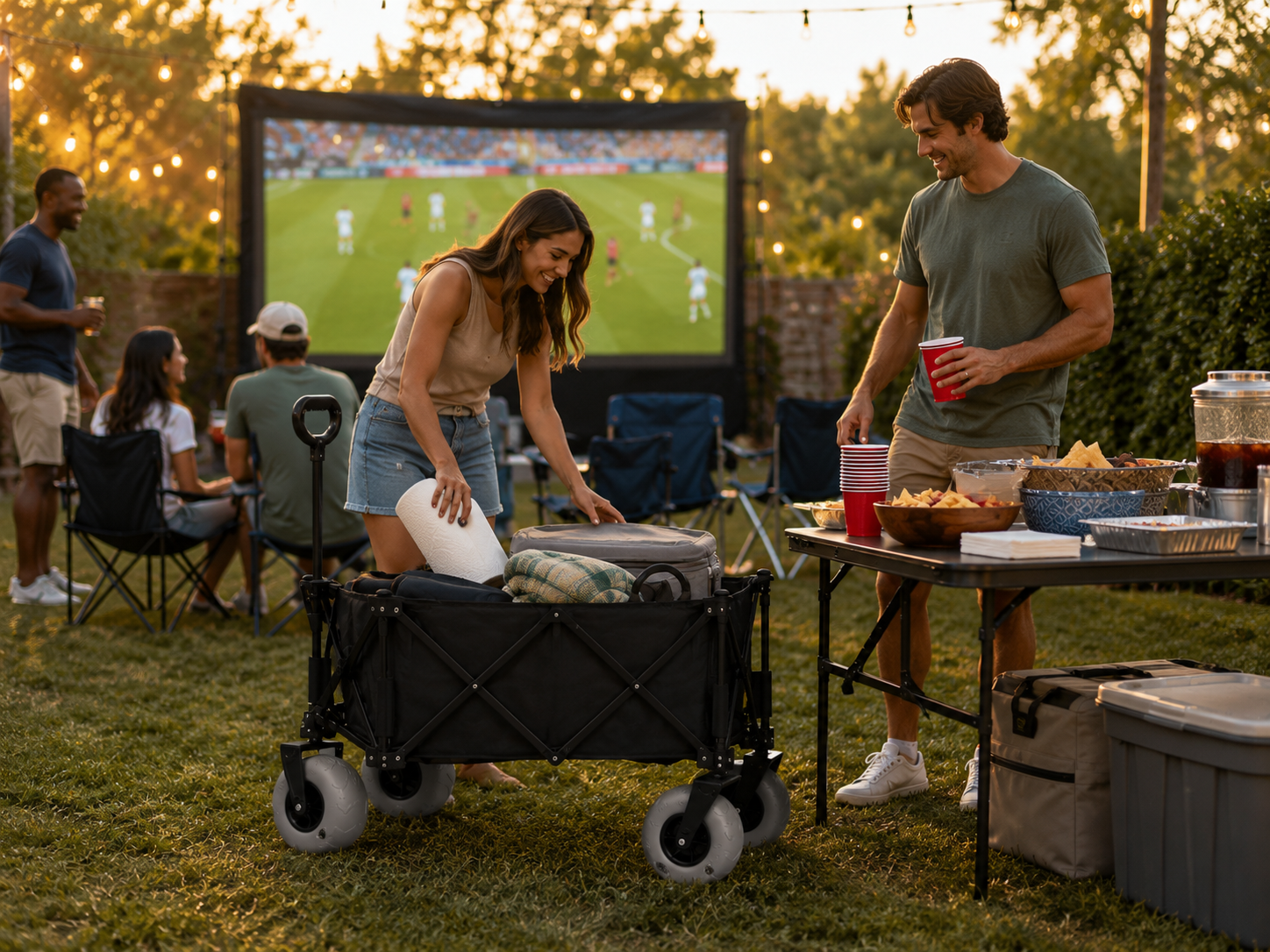
Upon landing, the retrieval process depends on the initial checking method. Gate-checked wagons are returned directly at the jet bridge. Standard checked carts are delivered to the oversized baggage area or the main luggage carousel. Once retrieved, the folding carts with collapsible wheels can be assembled to transport gear to a rental vehicle. At the destination, the foldable transport carts serve as reliable tools for hauling camping equipment over dirt paths, beaches, or grassy fields. For keeping your wagon in good condition after heavy travel use, the outdoor wagon care guide covers cleaning, storage, and maintenance in detail.
Key Tips to Avoid Problems With Airlines
Proactive planning and documentation reduce friction at the ticket counter, helping travelers manage unexpected airline baggage enforcement policies smoothly.
To avoid issues, travelers must confirm all baggage details directly with the carrier prior to departure, preferably securing written confirmation or screenshots of the policy.
It is also wise to take photographs of the collapsed wagon alongside a tape measure and document model specifications.
Building extra time into the airport arrival schedule allows for manual oversize screening and baggage processing.
Finally, keeping packing flexible—leaving extra space in primary suitcases—ensures that if the wagon must be checked separately, gear can be redistributed without incurring excess weight fees.

Is Traveling With a Folding Camping Wagon Worth It?
Assessing the benefits of terminal utility against the potential for baggage fees helps outdoor travelers determine if a collapsible wagon suits their itinerary.
The analysis indicates that while standard utility wagons are too large for cabin storage, they remain highly useful as checked or gate-checked items for outdoor-focused trips. The utility of moving heavy gear across long airport walkways and through campsites balances the effort of preparing the unit for flight. Treating the folding wagon as a component of an overall travel system ensures a more seamless, stress-free transit experience.
FAQs about Flying With a Folding Camping Wagon
Q1. Can a Camping Wagon Be Used Inside the Airport, or Must It Be Checked Immediately?
Most airports allow the use of collapsible wagons in the public ticketing lobby to transport gear to the counter. Yet, after checking in or prior to passing through security, the cart must either be checked into the hold or gate-checked. Terminal regulations and gate access differ across individual airports and air carriers.
Q2. Does a Folding Camping Wagon Count as Part of a Free Baggage Allowance?
In most cases, standard utility wagons do not qualify as free baby gear. They are treated as standard checked bags and count against your baggage allowance unless your airline states otherwise. If the wagon exceeds standard linear dimensions or weight limits, it will be subject to oversized or overweight luggage fees.
Q3. Can a Camping Wagon Be Packed With Gear Inside for Check-In?
Airlines require checked wagons to be completely collapsed and locked. While some carriers may allow thin, soft items like sleeping bags to remain inside the folded fabric, packing heavy or fragile equipment within the frame risks structural damage during handling. Heavy gear must always be distributed into padded suitcases. The heavy-duty wagon loading guide covers the most common packing errors and how to avoid them.
Q4. Are There Any Types of Camping Wagons That Airlines Are More Likely to Reject?
Airlines are highly likely to reject rigid, non-folding carts or wagons that do not collapse compactly, as they cannot be safely processed through baggage handling systems. Extremely large or heavy wagons that exceed maximum dimensional limits (such as 158 linear cm) or safety weight thresholds are also prone to rejection or significant surcharges.



Leave a comment
This site is protected by hCaptcha and the hCaptcha Privacy Policy and Terms of Service apply.